


- What Are the Real Pros and Cons of Affiliate Marketing for Betting Apps?
- How Can Programmatic Media Buying Scale Your Depositors?
- Which Channel Should You Choose for Each Growth Stage?
- Why You Need Both Channels to Scale
- FAQ
Use affiliates for low-risk, immediate FTDs when launching in newly licensed markets; turn to programmatic DSPs when hitting the affiliate volume ceiling, targeting live sporting events, and driving incremental scale. When mapping out a long-term roadmap for sport & betting apps growth, balancing both acquisition models is essential to maintain steady depositor volume without overpaying for traffic.
Affiliate marketing operates through external performance partners–primarily odds-comparison platforms, specialized tipster networks, betting review portals, and sports content sites, often managed through dedicated betting affiliate programs. The financial arrangement is almost exclusively performance-driven, centered on Cost per Acquisition (CPA) on a paying user or a multi-year Revenue Share agreement.
Pros:
- Zero-Risk Payment Models: Operators only release payment once a verified down-funnel action occurs–specifically an initial minimum deposit (FTD) alongside successful KYC clearance. If a referred user downloads the app but never deposits funds, media spend is zero.
- Users Are Already in the Mindset to Bet: Traffic originating from odds-checkers or prediction sites is pre-warmed. These users are actively searching for the best lines, odds boosts, or welcome promotions with an explicit intent to wager.
- Inherent Vertical Expertise: Affiliate channels already own the exact, pre-qualified audience for this specific vertical. They have spent years aggregating dedicated sports bettors, eliminating the upfront time, audience discovery costs, and exploratory media spend required on unspecialized channels.
Cons:
- Less Transparency and Placement Control: Traffic is frequently syndicated across multi-tiered sub-affiliate networks. This makes it difficult for operators to know where ads are displayed, verify creative context, or confirm the exact origin of newly registered users–raising compliance and brand-safety risks. As highlighted in AppsFlyer's mobile ad fraud research, regulated categories are frequent targets for device farms and proxy spoofing, making transparency critical.
- Limited Performance Feedback & Granular Insights: Because of this lack of full transparency, operators miss out on actionable campaign learnings. It is difficult to analyze which specific ad creatives drive the strongest conversion rates, or which app categories and publisher environments deliver the highest-quality depositors.
- Inflexible Pacing and Budget Caps: Affiliate networks lack the automated infrastructure of programmatic platforms. They cannot automatically pause campaigns or dynamically reduce delivery the exact moment daily caps or budget limits are reached. This often leads to overdelivery and requires manual coordination across multiple account managers, creating tedious, time-consuming work for advertisers.
- Finite Audience Pool and Fast Market Saturation: Because affiliate networks rely on a relatively fixed pool of dedicated bettors, they lack the capacity to drive true incremental growth over time. When multiple affiliate partners compete to promote the same betting app, saturation happens quickly as they target the same existing users, ultimately bringing long-term growth to an early stop.
Programmatic user acquisition operates through Demand-Side Platforms (DSPs) integrated into global ad exchanges via Real-Time Bidding (RTB). Instead of relying on static placements within gambling review sites, programmatic engines bid impression-by-impression across in-app ad inventories spanning virtually all app categories—from casual mobile games and utility apps to contextual sports and entertainment publishers.
Crucially, this broad coverage unlocks granular optimization capabilities: advertisers can whitelist top-performing environments or blacklist specific apps and entire low-converting categories to focus spend strictly on the inventory that delivers real depositors. By expanding reach to untapped sports audiences, programmatic media buying becomes the primary engine for accelerating sustainable sport & betting apps growth.
Pros:
- Reaches Untapped, Casual Sports Fans: Programmatic reaches broad audiences of sports enthusiasts and casual gamers who never browse affiliate blogs or comparison portals. This unlocks net-new players rather than recycling seasoned punters.
- Dynamic Dayparting Around Live Matchdays: Betting activity surges around game schedules. As highlighted in Sensor Tower's sports and mobile reports, major tournaments and marquee matches trigger exponential spikes in mobile acquisition. Programmatic DSPs capitalize on this by automating bid surges 60 to 120 minutes prior to kickoff, pairing real-time line updates and odds boosts directly with matchday schedules.
- Strict Geofencing and Compliance Control: Advanced DSPs verify device-level IP and GPS coordinates in real time. This ensures ad impressions serve strictly within legally licensed states or regions while automatically filtering proxy and commercial VPN traffic prior to bidding.
Cons:
- Upfront Testing Costs and Learning Curve: Programmatic media is typically bought on CPM or CPI models, which means achieving the desired CPA on First-Time Depositors (FTDs) and a positive ROAS is not instantaneous. As analyzed in industry benchmarks on mobile app user acquisition costs, moving from initial ad spend to optimized down-funnel conversions requires an upfront investment of both time and budget to collect data, test creatives, and train bidding algorithms before reaching consistent profitability.

The decision between affiliate networks and programmatic DSPs depends on your licensing status, timing around the sporting calendar, and financial risk tolerance. Aligning each channel to the right phase of your user acquisition journey ensures consistent sport & betting apps growth without exhausting marketing budgets:
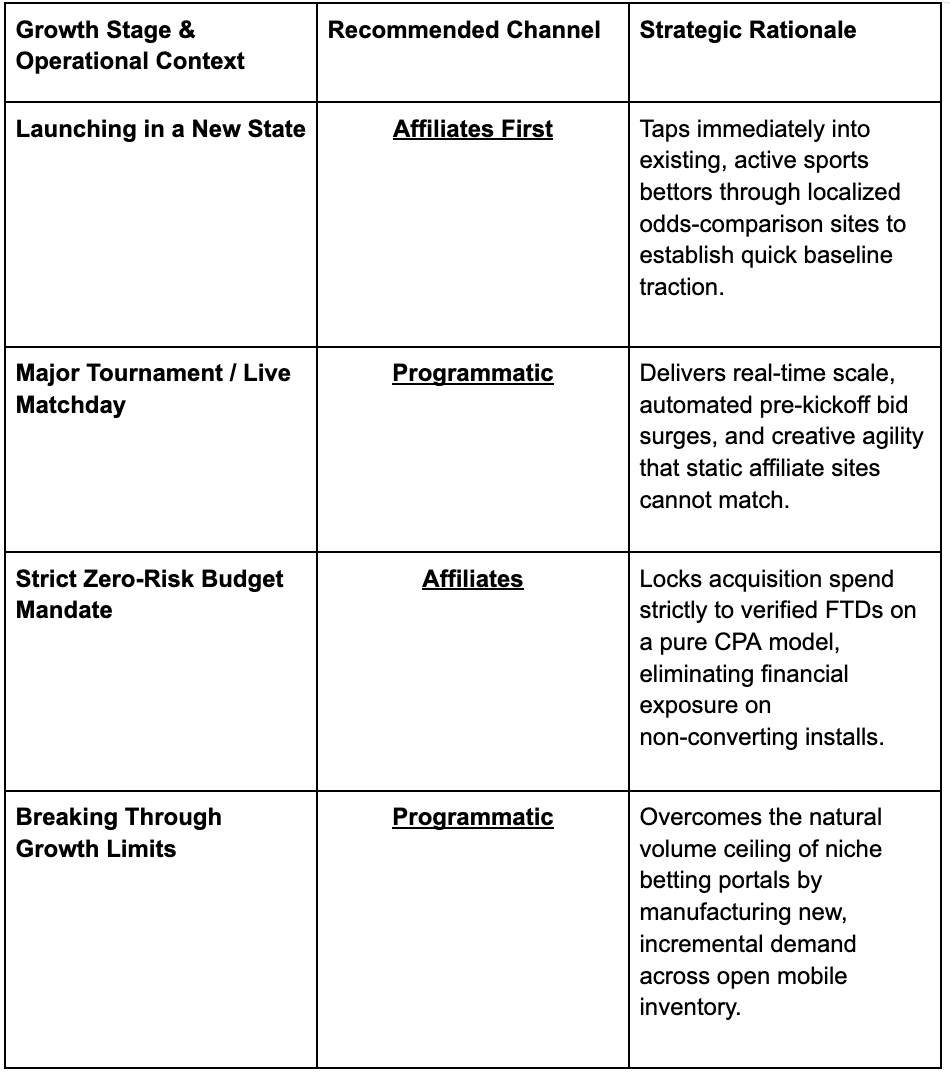
Neither channel should exist in a silo. Affiliate marketing offers an indispensable, low-risk foundation of deposit-ready users to establish immediate traction in a new market. However, programmatic media buying provides the transparency, real-time pacing control, and vast audience scale required to capture incremental sports bettors across the sporting calendar. For operators focused on compounding sport & betting apps growth, combining both channels creates the ideal balance between cost security and scalable performance.
What is the main difference between affiliates and programmatic buying for betting apps?
Affiliates operate on a performance-based CPA model using niche portals (like odds checkers and tipsters), offering a zero-risk payment model where operators only pay once a verified down-funnel action occurs—specifically an initial deposit alongside KYC clearance.
Programmatic buying uses automated Demand-Side Platforms (DSPs) to bid across broad in-app and mobile inventory, reaching new, untapped sports fans outside gambling sites.
Why can't betting apps rely solely on affiliate marketing?
Affiliates reach a finite audience of active bettors who already frequent comparison and review portals. Once an operator saturates the leading niche publishers in a licensed jurisdiction, incremental deposit volume hits a ceiling, making programmatic channels necessary to unlock new demand.
How does programmatic advertising handle strict betting regulations and live events?
Advanced DSPs enforce real-time IP and GPS geofencing to ensure ads only appear in legally licensed regions, automatically filtering out VPN traffic. Additionally, they enable dynamic dayparting to automatically surge bids 60 to 120 minutes before match kickoff.


