

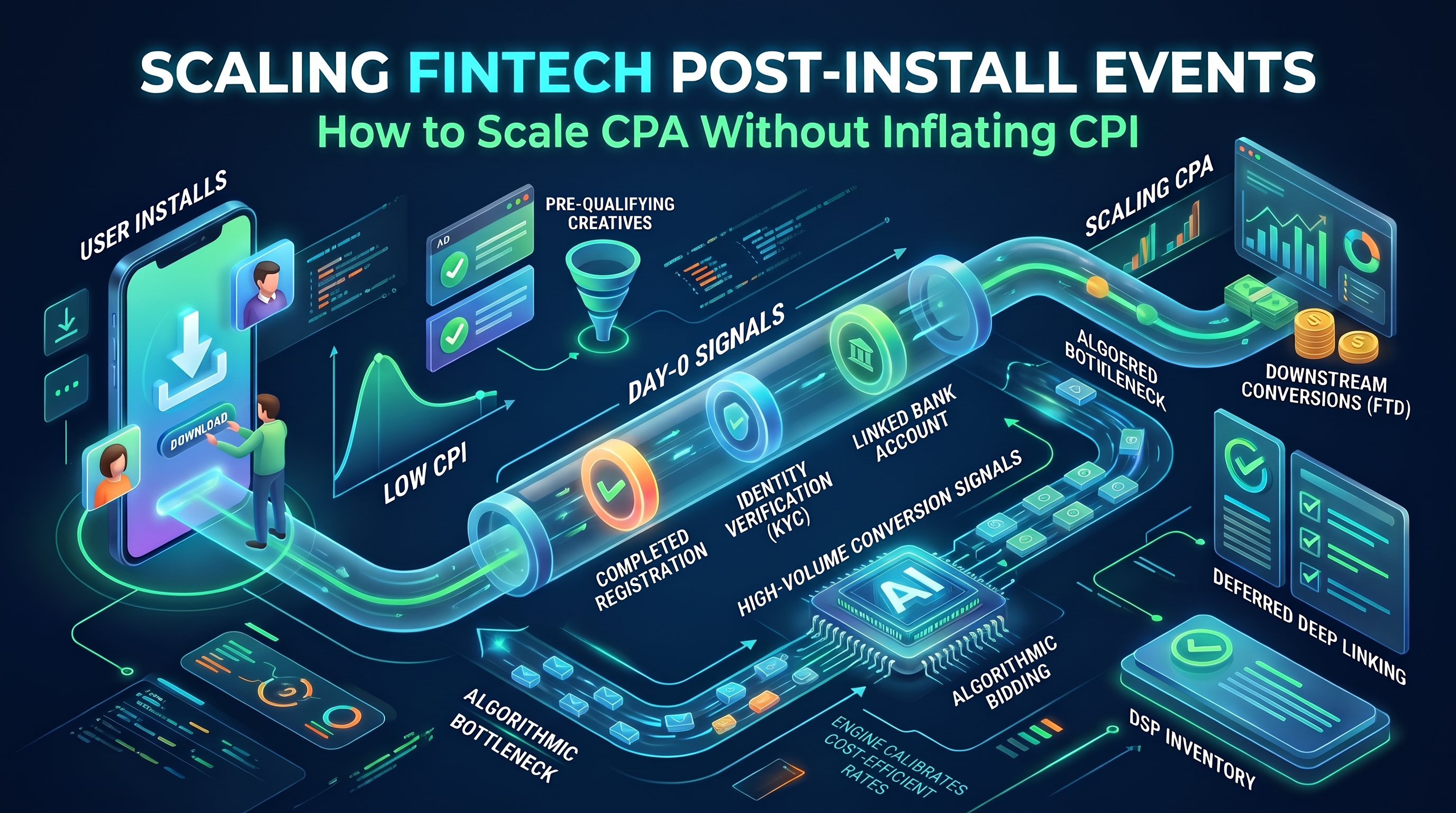
- Why Does Optimizing Directly for CPA Drive Up Your CPI?
- How Should Finance Apps Choose the Right Early Post-Install Event for Their CPA Campaigns?
- How Do Pre-Qualifying Creatives Help Scale Post-Install Events?
- The Fintech Post-Install Scaling Checklist
- FAQ
Scaling post-install events without inflating your Cost Per Install (CPI) requires anchoring automated bidding models to early, high-frequency actions completed within the first 24 hours of install rather than waiting on low-volume First-Time Deposits (FTD). Effective fintech app CPA optimization pairs these rapid Day-0 signals with pre-qualifying ad creatives filters out unmotivated clicks before download, keeping baseline acquisition costs competitive while driving qualified users into the onboarding funnel. This balance allows fintech advertisers to unlock downstream conversion volume without triggering algorithmic bidding wars in mobile ad auctions.
If you are scaling a neobank, trading platform, or personal finance app, learn more about how we drive efficient conversions via Mapendo’s fintech user acquisition solutions.
In mobile user acquisition, telling an ad network or programmatic DSP to optimize directly for a bottom-funnel event—such as a funded account or a $100 deposit—immediately triggers an algorithmic data bottleneck that undermines sustainable fintech app CPA optimization.
Machine learning bidding models thrive on consistent, frequent conversion signals, typically requiring dozens of successful events recorded every day to learn which user profiles are most likely to convert. Because financial commitments involve trust barriers, document uploads, and identity checks, only a small percentage of users complete an FTD right away. Setting your optimization event directly on the deposit starves the bidding algorithm of positive feedback—often stretching multiple days between single conversion signals—leaving the engine unable to reliably identify lookalike characteristics across a broader audience.
Under these data constraints, the bidding model becomes defensive and concentrates bids on a tiny, known cohort of high-intent financial converters. Because competing fintech apps are targeting that exact same small pool, ad auctions become intensely congested. Bid floors spike, and top-of-funnel CPI rises rapidly as the algorithm pays premium rates to secure scarce impressions.
This dynamic triggers three direct problems for media buyers:
- Constrained reach, as the campaign throttles delivery when the bidder refuses to serve ads outside users with an established deposit history.
- Delivery instability, where days with zero or low deposits cause wild swings in bid values and erratic pacing.
- Inflated blended CAC, because even if acquired users convert into depositors, paying double or triple for the initial install inflates overall acquisition costs beyond profitable margins.
To keep your CPI low and delivery smooth, the key to fintech app CPA optimization is finding a mid-funnel event that bypasses the deposit delay while still filtering for high intent.
Modern mobile ad networks and privacy frameworks (such as Apple’s SKAdNetwork Apple’s SKAdNetwork and Google’s Privacy Sandbox are heavily weighted toward what happens immediately after the download, adjusting bids based on telemetry generated in the first 24 hours post-install. If an action typically takes 3 to 7 days for a user to complete—such as waiting for manual KYC approval, transferring funds from an external bank, or deciding on a stock purchase—it simply arrives too late to guide auction bidding effectively.
Instead of waiting for an eventual deposit, look closely at your Day-0 onboarding path. By analyzing internal organic data, finance apps can identify which early milestone historically correlates most strongly with turning a new user into a paying customer. You need an upstream action that occurs shortly after launch and reliably indicates that intent, such as:
- Completed account registration via phone or email verification,
- Initiated identity verification where the user submits personal details,
- An uploaded document or verification selfie, or
- A linked bank account established via open banking.
These actions happen in the first session or within hours of the download, providing the bidder with a steady, predictable flow of conversion signals.
Ultimately, an effective early optimization milestone satisfies two conditions at once. First, it generates sufficient volume, logging enough daily events for the machine learning model to continuously calibrate bids and uncover cost-effective inventory. Second, it creates a meaningful commitment barrier, requiring enough user effort that accidental downloaders are weeded out—since a user rarely inputs a social security number, photographs a passport, or connects bank credentials unless they genuinely plan to use the service. Training ad models on this early signal builds steady momentum, keeps the algorithm out of the expensive narrow-audience trap, and maintains an affordable base CPI.

Bidding algorithms only handle distribution; user psychology determines post-install conversion. A major driver of low event completion rates in fintech app CPA optimization is a disconnect between the promise of the ad and the reality of the app's onboarding flow.
Ad creatives that promise "open an account in 10 seconds" or emphasize superficial perks often generate cheap clicks and high install volume. However, these users churn immediately when confronted with standard fintech compliance checks, resulting in a low install-to-event rate and an inflated CPA.
Pre-qualifying creatives solve this by introducing intentional friction to filter out passive users before the install happens:
- Highlight compliance requirements directly in the copy or on-screen text with clear disclaimers like "Quick setup with valid government ID" or "Must link a bank account to activate."
- Preview the in-app flow by incorporating short, 2-to-3-second screencasts showing the actual verification steps or security features so prospective users know what to expect.
- Deter low-intent browsers before money is spent, ensuring that users unwilling to verify identity keep scrolling and budget is reserved for motivated installers.
Once a pre-qualified user installs, preserving momentum is critical. Dropping the user onto a generic home screen introduces immediate friction and hesitation. By implementing Deferred Deep Linking (DDL) via your Mobile Measurement Partner (MMP), you can route the new installer straight into the dedicated registration tier or offer highlighted in the ad. Removing this navigational friction accelerates early session actions, enabling users to complete post-install verification faster and at significantly higher rates.
Executing a sustainable fintech app CPA optimization strategy requires aligning every level of your acquisition pipeline:
Funnel Architecture
- Identify an early Day-0 proxy event: Select a commitment action completed within 24 hours of install (such as KYC document submission) rather than waiting on delayed deposits.
- Verify daily conversion volume: Ensure ad sets log sufficient daily conversion signals to maintain algorithmic bidding stability.
Creative & Attribution
- Embed onboarding friction into creatives: Mention ID and compliance requirements in ad copy to filter out low-intent clicks before install.
- Configure Deferred Deep Linking (DDL): Route new users straight from the ad click into the promised onboarding screen.
Optimization
- Set up real-time exclusion lists: Suppress existing accounts and verified users via server-to-server (S2S) feeds to prevent wasted spend.
- Scale across programmatic DSP inventory: Diversify into independent in-app exchanges to access cost-effective inventory free from social auction congestion using dedicated partners like Mapendo’s performance engine.
What is a good cost per FTD for a trading or fintech app?
In Tier-1 markets (US, UK, and Western Europe), average cost per First-Time Deposit typically falls between $70 and $150 for consumer neobanks and digital wallet apps. For trading, wealth management, and cryptocurrency platforms—where deposit minimums and expected lifetime values are higher—cost per FTD generally ranges between $150 and $350+. Structuring your campaigns around proper fintech app CPA optimization helps compress these acquisition costs across all stages.
Should I optimize for installs or post-install events when launching a new campaign?
Start by optimizing for installs or an early onboarding step (such as account creation) during initial testing. This establishes baseline attribution paths, confirms tracking integrity, and generates initial telemetry. Once campaigns demonstrate steady delivery, shift optimization to a qualified 24-hour event like document upload or identity verification.
How does programmatic DSP traffic help stabilize fintech CPI?
Major walled gardens often experience fierce auction competition because thousands of advertisers bid simultaneously on the same narrow demographic segments, which quickly drives up CPI. Programmatic DSPs evaluate granular real-time signals—such as app category context, device specifications, and placement type—across independent in-app exchanges. This enables buyers to uncover cost-effective inventory that delivers reliable post-install conversions without paying premium social auction rates.
Looking to scale verified users and deposits at sustainable unit economics? Explore how Mapendo’s performance marketing engine for finance apps connects programmatic scale with full-funnel conversion tracking.


