- Answer Engine Optimization (AEO)
- "Zero-UI" Usage
- Web-to-App Funnels
- Autonomous AI Decisioning
- Hybrid Models and Performance-Only Creators
- FAQ
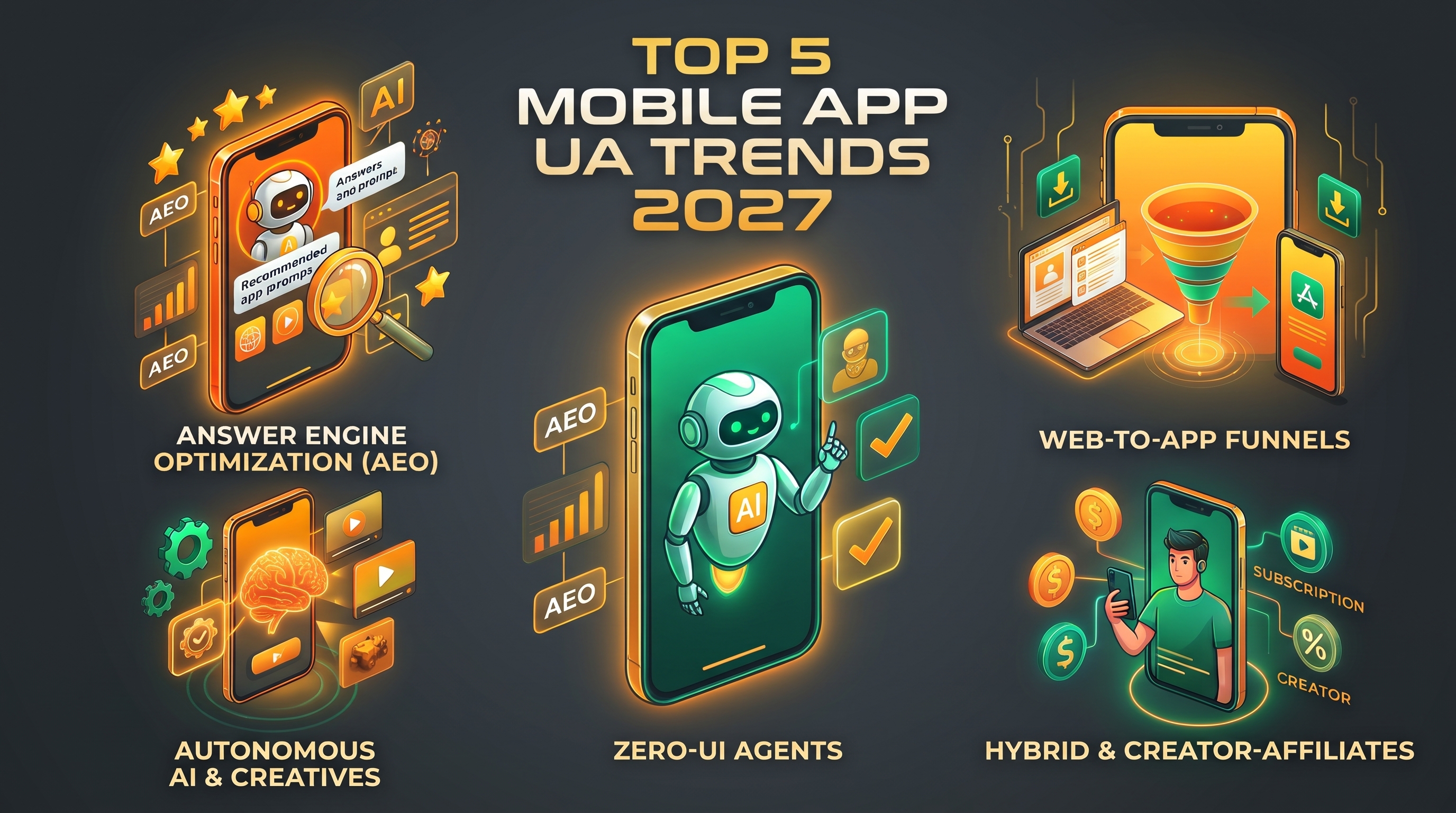
The top five mobile app UA trends 2027 marketers need to prioritize are Answer Engine Optimization (AEO) for AI-driven discovery, zero-UI agentic app usage, Web-to-App acquisition funnels, autonomous AI decisioning fueled by creative supply, and hybrid monetization paired with performance creator-affiliates. To scale mobile app user acquisition profitably in 2027, growth teams must shift budgets away from raw install volume toward post-install ROAS, feed clean first-party signals into programmatic DSPs, and diversify acquisition beyond traditional app stores.
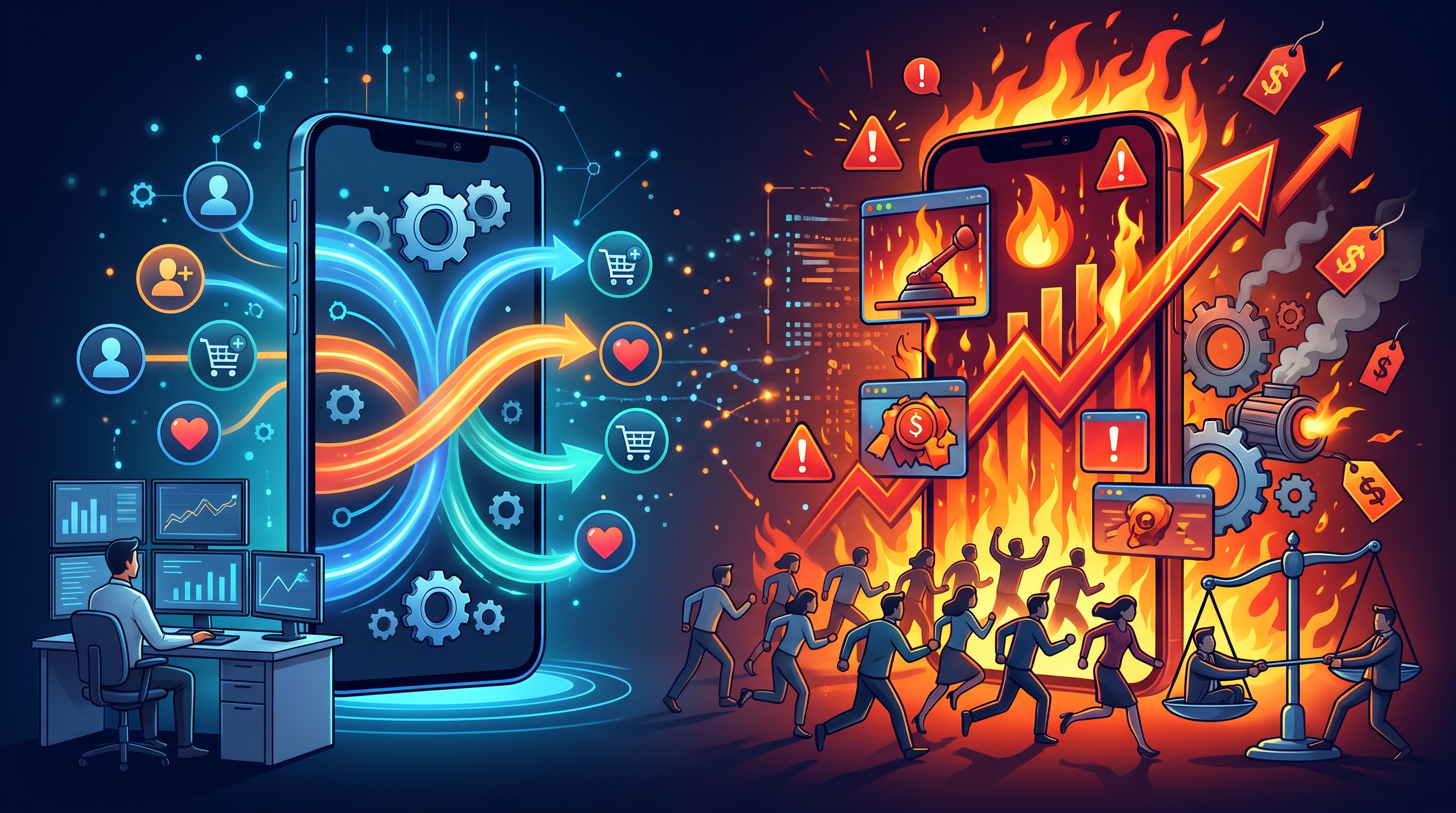
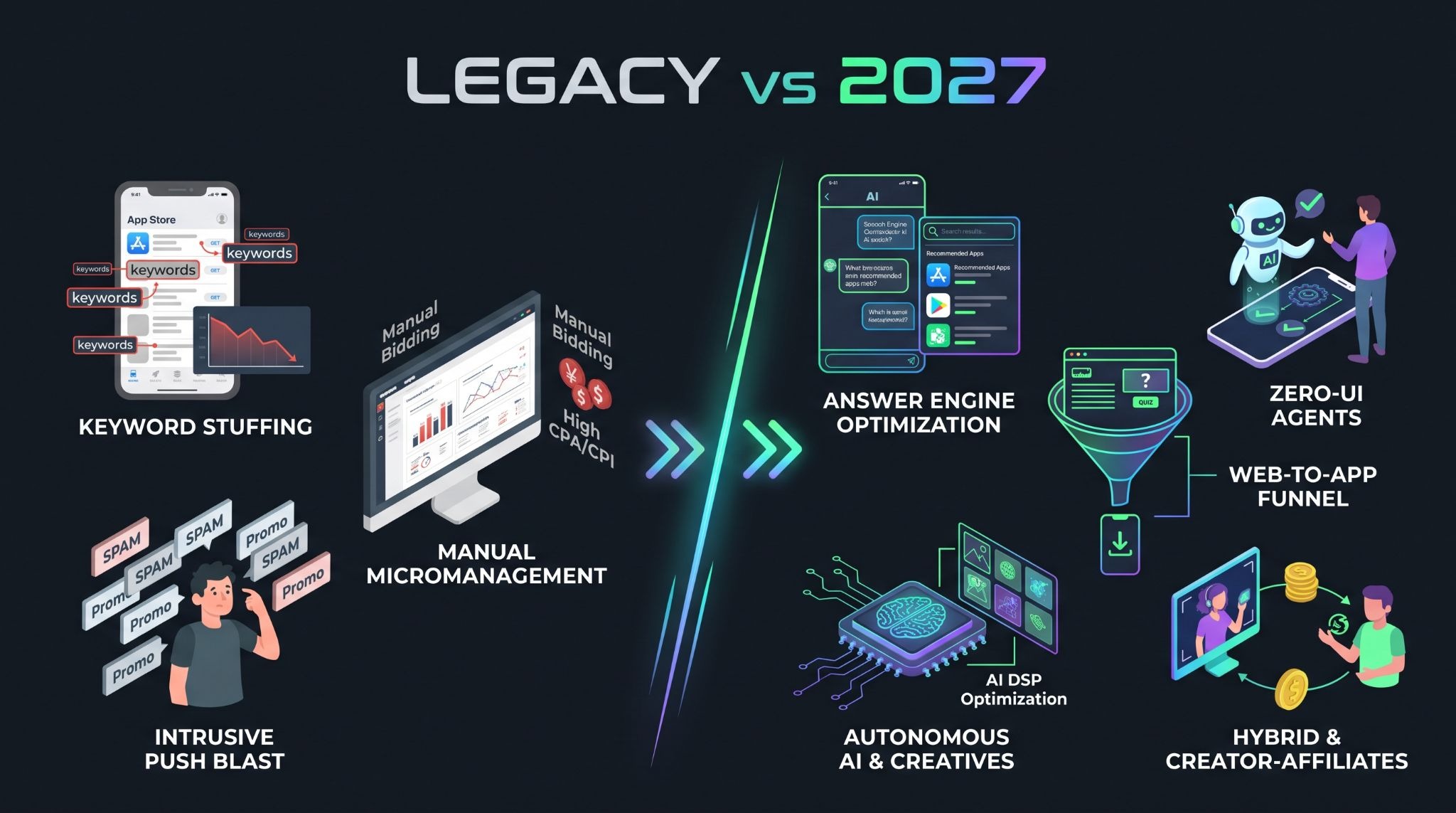
Legacy mobile user acquisition tactics—such as App Store keyword stuffing, manual bid micromanagement, and generic static social ads—are rapidly losing effectiveness. Driven by OS-level artificial intelligence, stricter privacy frameworks, and rising acquisition costs across saturated social channels, mobile marketers are being forced to fundamentally rethink how users discover, install, and engage with apps.
Below is a practical breakdown of the five shifts defining mobile growth in 2027—and how to adapt your strategy.
For over a decade, App Store Optimization (ASO) meant optimizing titles, subtitles, and keyword fields to rank inside Apple’s App Store and Google Play. Heading into 2027, a growing share of mobile app user acquisition and organic discovery no longer starts in an app store search bar—it starts inside conversational AI assistants like ChatGPT, Gemini, and Perplexity.
Instead of scrolling through top charts, users ask natural-language questions such as "What is the best budgeting app for freelancers?" or "Which language app focuses on conversational practice?" Large Language Models (LLMs) do not rank apps based on store keyword density alone. Instead, they synthesize recommendations using external web authority, structured comparison articles, verified user sentiment, and clear product positioning across the open web. In 2027, AEO works alongside ASO: while ASO converts users once they land on your store listing, AEO ensures your app gets recommended in the first place—reinforcing paid mobile app user acquisition campaigns with higher-intent organic discovery.
AEO Readiness Checklist:
- Audit AI visibility: Query major AI assistants for your category’s top use cases to see how your app is described—or if competitors are being recommended instead.
- Build authoritative web mentions: Invest in digital PR, structured product comparisons, and credible third-party reviews that LLMs use as citation sources.
- Align store copy with conversational intent: Rewrite App Store descriptions to clearly answer specific user problems rather than repeating isolated keywords.
With OS-level ecosystems like Apple Intelligence and Android AppFunctions maturing, mobile devices are shifting from app-centric interfaces to agentic execution. In 2027, AI assistants increasingly perform tasks inside apps on the user's behalf—booking rides, checking balances, ordering groceries, or summarizing messages—without the user ever opening the app’s home screen. At the same time, AI-powered notification summaries automatically group and silence generic promotional push blasts.
For growth and retention teams, this "Zero-UI" reality breaks traditional engagement playbooks and changes post-install mobile app user acquisition. Chasing daily app opens or sending high-frequency push notifications no longer correlates with retention. Instead, marketers must optimize for deep-linked task execution, lock-screen Live Activities, and home-screen widgets that deliver value instantaneously, especially across on-demand and utility apps.
Shifting from Legacy to Agentic Engagement:
- Move from app opens to task completion: Instead of measuring success by daily active sessions, track how smoothly users complete background actions triggered via OS assistants or deep links.
- Replace generic push blasts with live widgets: Since AI filters out repetitive promotional notifications, focus on lock-screen Live Activities and interactive widgets that surface real-time utility without requiring a full app launch.
- Optimize deep-link conversion paths: Ensure every external trigger lands the user directly on the specific action screen rather than a generic home feed.
Facing 15% to 30% app store transaction fees and ongoing attribution blind spots under mobile privacy frameworks, performance marketers are aggressively scaling Web-to-App mobile app user acquisition funnels. Rather than sending paid clicks directly to an App Store listing, growth teams route programmatic and social traffic to a dedicated mobile web landing page or interactive onboarding quiz.
In a Web-to-App flow, the user answers tailored onboarding questions, sees a personalized value proposition, and completes account creation or payment via a web checkout provider before downloading the app via a deep link. This approach is particularly effective for subscription and lifestyle apps looking to protect unit economics while gaining full visibility into upper-funnel user intent.
Key Advantages Checklist:
- Protect net margins: Bypass or reduce standard app store commission fees by processing initial subscriptions on the web.
- Recover attribution accuracy: Capture deterministic first-party conversion signals in a web environment before mobile OS tracking limits apply.
- Pre-qualify high-intent users: Use customizable multi-step web quizzes to educate users and boost trial-to-paid conversion rates prior to install.
In 2027, modern AI-powered Demand-Side Platforms (DSPs) manage real-time bidding, audience modeling, and per-user ad decisioning autonomously. Because machine learning algorithms now handle micro-targeting far better than human media buyers, manual bid adjustments and granular audience slicing have become obsolete.
When the algorithm controls delivery, campaign performance depends almost entirely on two human-controlled inputs: creative supply and post-install first-party data signals. Without a steady pipeline of diverse creative formats—such as playable ads, interactive videos, and native UGC variations—algorithms quickly hit creative fatigue. Likewise, without clean post-install event feedback (such as purchases, level completions, or subscriptions), the DSP cannot distinguish high-LTV users from low-value installers. This dynamic is especially visible in competitive mobile gaming user acquisition where creative testing velocity directly dictates CPA and ROAS stability.
Creative & Signal Framework:
- Adopt modular creative production: Break video and playable assets into interchangeable hooks, core gameplay or product demos, and end-cards so you can refresh variations every two weeks without rebuilding from scratch.
- Pass deep-funnel signals to your DSP: Optimize programmatic campaigns around post-install CPA or ROAS milestones rather than top-of-funnel CPI.
Consumers are experiencing widespread subscription fatigue, leading to higher cancellation rates for apps locked behind rigid monthly paywalls. Simultaneously, traditional influencer marketing based on flat upfront fees has become too risky for performance-driven UA budgets.
To solve both challenges in 2027, leading apps are combining hybrid monetization with performance creator-affiliate programs. On the monetization side, apps pair a core subscription tier with consumable credits, pay-as-you-go bundles, or one-time feature unlocks to capture users who refuse recurring billing. On the acquisition side, growth teams are shifting creator partnerships away from fixed sponsorships toward pure performance payouts—such as Cost Per Action (CPA), Cost Per First-Time Deposit (FTD), or revenue share—aligning creator networks with the same unit-economics standards used in programmatic fintech and trading app marketing.
Aligning Performance Channels:
- Unify payout events across channels: Hold both your programmatic DSPs and creator-affiliate partners to the exact same downstream conversion event (such as completed registration, FTD, or paid conversion) to maintain consistent ROAS across your entire media mix.
What is the difference between ASO and AEO for mobile apps?
App Store Optimization (ASO) focuses on optimizing app store metadata—such as titles, keywords, and screenshots—to rank higher inside Apple’s App Store and Google Play. Answer Engine Optimization (AEO) focuses on building authoritative web mentions, structured comparisons, and clear product positioning so AI assistants like ChatGPT and Gemini recommend your app in conversational search results.
Which app categories benefit most from Web-to-App funnels?
Subscription-based apps—including health and fitness, language learning, productivity, lifestyle, and fintech apps—benefit the most from Web-to-App funnels. These categories rely heavily on personalized onboarding quizzes to communicate value and gain substantial margin improvements by processing subscriptions through web payment gateways.
What matters most when running campaigns on an AI-powered DSP in 2027?
Because AI-powered DSPs automate bidding and audience targeting, the two most critical success factors are a continuous supply of fresh, varied ad creatives (playable, video, and interactive formats) and accurate post-install first-party conversion signals (such as CPA or ROAS events) to guide algorithmic optimization.
How can app marketers measure ROAS accurately despite stricter privacy rules?
App marketers measure ROAS in a privacy-first environment by combining contextual targeting signals, probabilistic attribution modeling, and aggregated post-install conversion feedback passed directly from their MMP (Mobile Measurement Partner) to their programmatic DSP—allowing algorithms to optimize for revenue without relying on invasive user-level identifiers.