Here's the honest answer: there's no single magic channel.
The best approach is a clear, repeatable process with a smart mix of channels. Most successful campaigns start like this:
- Decide what you want from UA. Huge volumes of new users fast or focus on acquiring paying/high-LTV customers?
- Choose your channels, plural. We always recommend a mix: self-service platforms, performance-based networks, DSPs and rewarded channels each reach different people.
- Pick your partners. Look for ones who optimize toward your real goals, not just cheap installs.
- Set up a mobile measurement partner (MMP). It's your single source of truth.
- Set your budget. Big enough for each channel to collect real data.
- Launch with a test. Small budget, fixed time window, clear definition of success.
- Keep monitoring after launch. The real story shows up in the weeks that follow.
1. What goals and KPIs should you set before launching mobile UA campaigns?
Your goal decides how the whole campaign is bought, optimized and judged, so lock it in before you spend a dollar. Most apps start from one of two places.
New to the market? You might want volume. A new app needs users to climb store rankings, build social proof and collect data. In this case, your main KPI could be the number of installs, with CPI (cost per install) as your cost target: you pay for each install and aim for as many as possible at a price you can afford.
Already have users? You might want value. Now you care about what users do next: register, subscribe or spend money in the app. Here your main KPI could be the number of users who complete a key action, like a first purchase, with CPA (cost per action) as your cost target.
This choice shapes everything that follows. Algorithms optimize for exactly what you ask for: ask for installs and you get installs, ask for purchases and you get fewer but more valuable users. A CPA campaign will usually cost more than a CPI campaign, and that's fine as long as those users pay you back. Just remember that a new user doesn't automatically bring revenue, so always compare your ad spend against real events like sign-ups or purchases.
Before launch, write down your main KPI with a target number, plus one or two supporting metrics such as retention or ROAS, each tied to a fixed time window like D7 or D30.
2. Why do you need a mobile measurement partner (MMP), and how do you set it up?
MMP is a third-party company, whose platform collects your install and in-app data from every channel, figures out which ad actually brought each user, and puts it all in one dashboard. Think of it as the referee of your UA: when several ad networks claim the same install, the MMP gives the credit only once.
Here's what an MMP gives you:
- One source of reliable data across all your channels.
- Attribution that shows which channel, campaign and creative brought each user.
- Post-install metrics like retention, revenue and ROAS.
- Fraud protection that keeps fake installs out of your reports and invoices.
- Privacy-friendly measurement that keeps working on both iOS and Android, even as privacy rules get stricter.
The best-known MMPs are AppsFlyer, Adjust, Singular, Kochava and Branch. All cover the essentials; they differ in pricing, features and how well they fit the partners you plan to use.
Setup is easier than it sounds. Your developers add the MMP's SDK to the app, and you choose which in-app events to track. Then reach out to your UA partners and MMP account manager: they'll connect your campaigns and check that everything is tracked correctly before you spend real money.
3. How do you choose and test UA partners and channels?
The right channel mix depends on the goal you set in the first paragraph and on your budget. Each channel type brings something different. Self-service platforms like Google, Meta and TikTok give you huge reach and automated bidding. Performance-based networks let you pay only for results. DSPs bid automatically across thousands of independent apps, and rewarded channels deliver high volume at lower costs by giving users an in-app reward for engaging.
Small budget? Focus. Split a small budget across five partners and none of them gets enough data to learn. Pick the one most likely to bring the best return, prove it works, then expand.
Bigger budget? Diversify. Running several channels in parallel lets you reach different audiences and keeps you safe if one channel suddenly gets expensive.
Either way, test before you scale:
- Start small with a test budget, a fixed time window and a clear success target.
- Compare fairly, using the same KPI and the same MMP data for every partner.
- Keep creatives fresh. With AI handling bidding and targeting, performance depends heavily on a steady supply of new creatives and clean post-install data. mapendo
- Scale the winners and pause the rest.
4. How do you measure and optimize UA performance over time?
UA performance is never instant. Users keep spending for weeks and months after they install, so judging a campaign on day one almost always undervalues it. That's why teams track ROAS (return on ad spend) at fixed points after install:
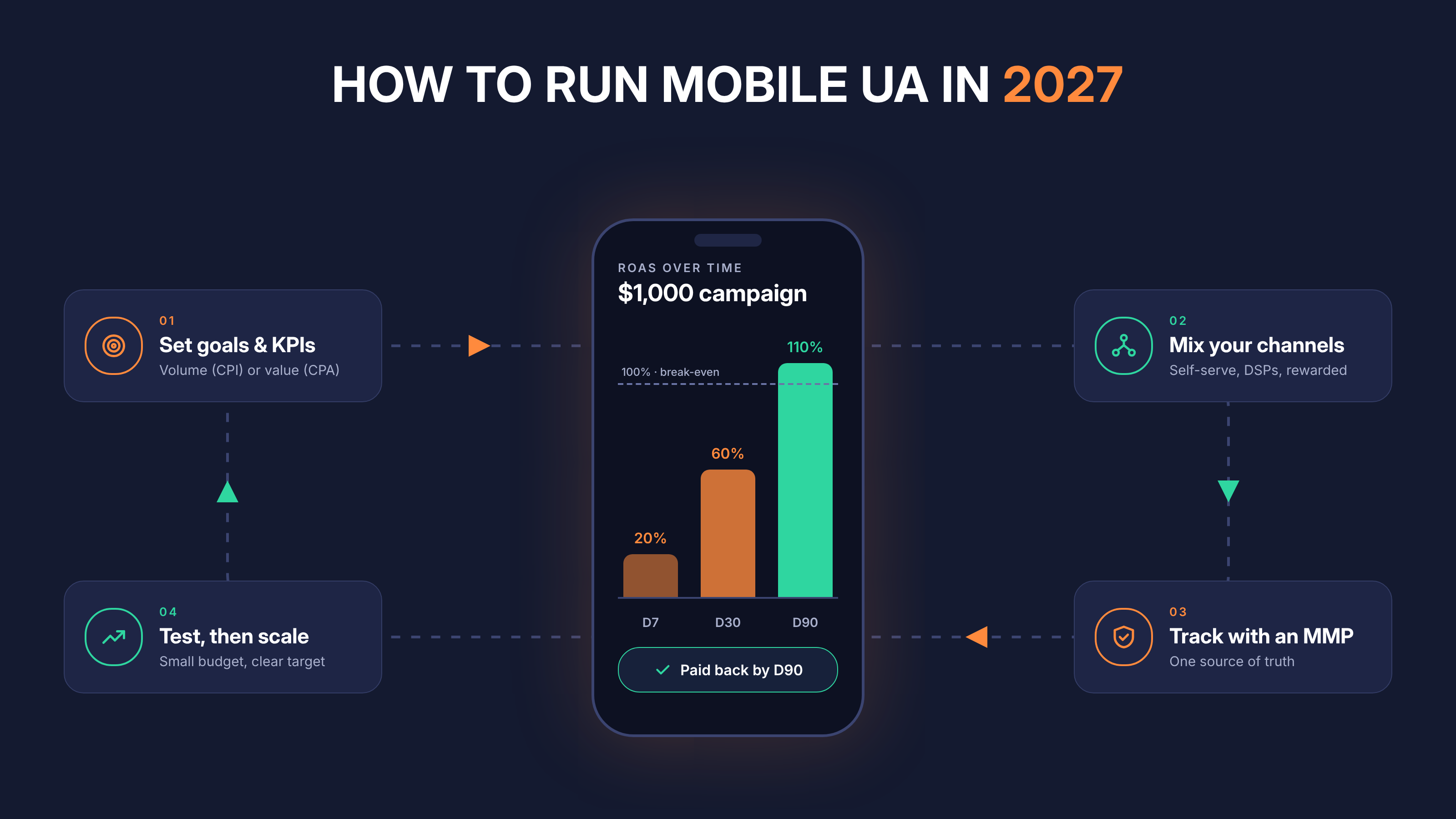
- D7 ROAS is your early signal. It shows whether users are engaging and starting to pay. A low D7 is a warning, not yet a verdict.
- D30 ROAS is where most decisions happen. By now you can compare channels with confidence and move the budget toward the winners.
- D90 ROAS shows long-term value. It tells you whether a channel truly pays back, which matters most for subscription apps and games with deep in-app economies.
For example, imagine you spend $1,000 on a campaign. If those users generate $200 in their first 7 days, your D7 ROAS is 20%. If they reach $600 by day 30 and $1,100 by day 90, the campaign has paid back and turned profitable, even though it looked weak after the first week.
Two things keep your reading honest.
First, compare cohorts of the same age: users who installed last week haven't had time to earn their 90-day revenue yet. Second, pick the time frame that fits your app, because every category earns money at its own pace. Hyper-casual games, for example, have high user turnover, so most of their revenue comes in the first days after install. For them, D7 or D14 ROAS is often the right metric. Action and strategy games work differently: players keep coming back for weeks to advance in the game, so these games look at longer-term metrics like D30 ROAS and beyond. You can check typical numbers for your own category with the Mapendo Benchmark Calculator. mapendo
Then optimize: shift budget toward the channels whose ROAS climbs fastest, and refresh creatives before performance fades.
Conclusion
So, what's the best way to run mobile User Acquisition in 2027? There's no shortcut, but there is a loop: know what a valuable user looks like for your app, measure it the same way everywhere, test in small steps, and give your data time to tell the truth.
We've kept things simple here, but in practice every step of that loop comes with its own challenges, from choosing the right KPI to reading ROAS correctly across channels. That's why it helps to work with an experienced UA partner like Mapendo :) who can plan your campaigns with you and keep a clear view of what's working, whether results come in above or below expectations.
The apps that grow profitably aren't chasing the cheapest install. They treat UA as an ongoing experiment, not a one-time launch. Start focused, stay curious, and scale what proves itself.