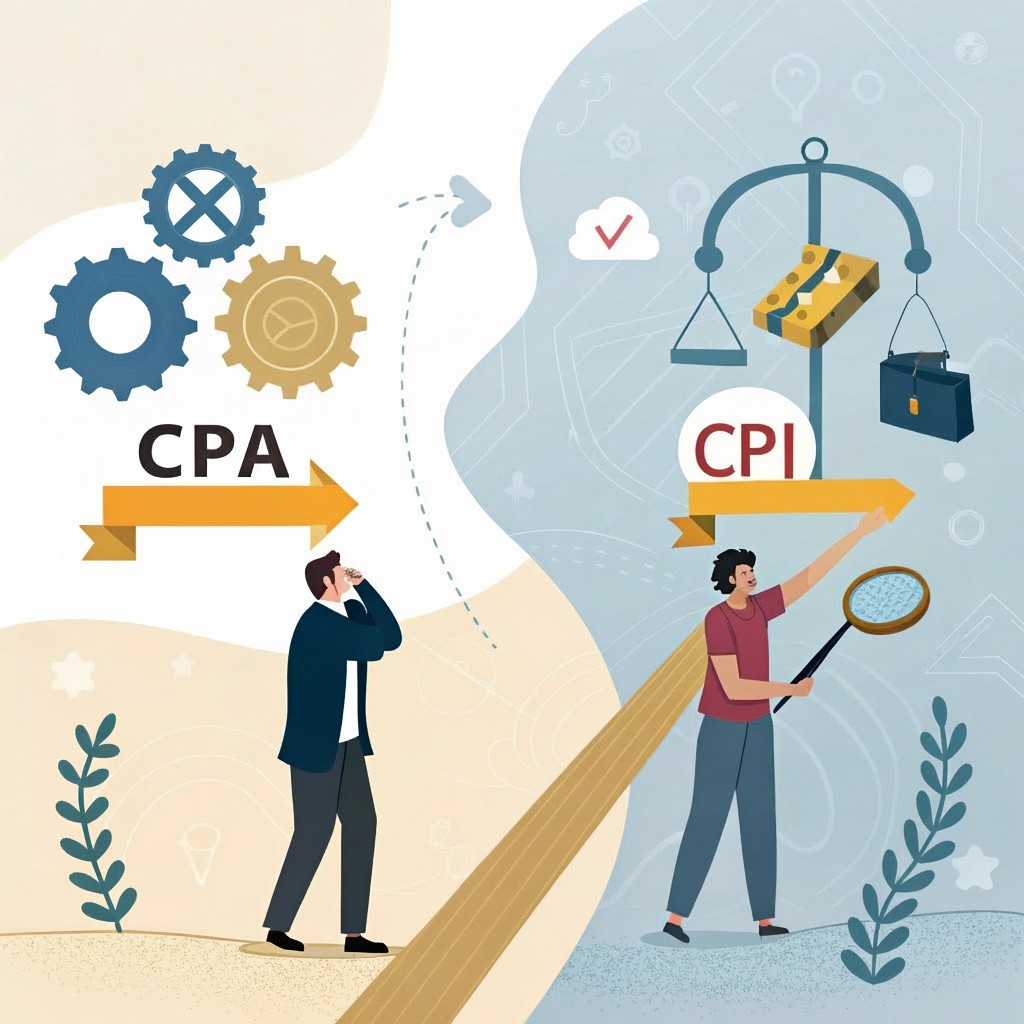
- CPA
- CPI
- Differences Between The Two Models And How To Combine Them
When it comes to user acquisition campaigns for mobile apps, advertisers usually opt between two choices: Cost per Instal and Cost per Action, commonly known as CPI and CPA. CPI and CPA are the most used commercial models in app install campaigns, and not competing strategies, diverging in practical execution. But which are the benefits of each choice? And how can one tell which one is better for the goals they are trying to achieve?
The Cost per Action (CPA) model is a pricing model commonly applied in app install campaigns. Within this model, advertisers pay only when a specific action takes place. The term action refers to a post-install event performed by the app user, such as an in-app purchase or a registration, that are either directly related to app monetisation or that are good indicators of high user quality.
Moreover, the CPA model aims at acquiring high-quality users who are more likely to engage and keep performing valuable actions within the app after installation. In fact, CPA campaigns provide detailed information about user behavior by allowing advertisers to track post-install events throughout the user journey.
CPA app campaigns are considered relatively low-risk for advertisers, as they pay only after the desired action has been completed. Should a user fail to complete the desired action, the advertiser does not have to pay for the efforts required to bring the customer to the brand. Furthermore, CPA is a valuable tool in terms of performance measurement and attribution, as it allows advertisers to clearly identify which sources lead directly to valuable actions, thereby supporting more informed campaign decisions.
Cost per Install (CPI) is a widely used pricing model in which advertisers are charged based on the number of installs generated by their campaigns. Developed in response to the need for measurable and precise results, the CPI model allows mobile advertisers to pay only when their app has been successfully installed as a result of an advertisement.
This strategy aims to generate a high volume of new users. In particular, when utilizing a tech-driven ad network, advanced targeting methods can be employed not only to help marketers acquire a larger user base, but also to ensure that these users belong to the desired target audience. However, focusing primarily on increasing the number of new users can lead to overlooking their quality. Acquired users may not become high lifetime value (LTV) users.
Several factors influence CPI, including app category, geographic region, and operating system. Each app category has unique characteristics that significantly affect CPI, depending on factors such as competitiveness, target audience, and user engagement potential.
Regions with higher socioeconomic status and purchasing power often exhibit higher CPI rates, as users in these areas tend to spend more on apps. This aspect is closely linked to the operating system. iOS generally shows higher acquisition costs due to its strong presence in wealthier regions. Conversely, Android, which is more dominant in areas with lower socioeconomic status, tends to have lower CPI rates. Additionally, external and unpredictable factors such as seasonality, competition, and market trends also influence CPI, making it difficult to accurately predict costs.

CPI and CPA are both performance-based pricing models, meaning that advertisers only pay for concrete results. The substantial difference between CPI and CPA is the focus of optimization : Cost Per Install focuses on installs, and thus new users, while Cost Per Action focuses on in-app events, ideally increasing app revenues.
In terms of costs, CPA campaigns are generally more expensive and more complex to set up and manage, since they require more sophisticated tracking and optimization. This explains why CPA involves a higher cost while CPI is generally less expensive. Furthermore, CPI and CPA also differ in monitoring: Cost Per Install is easier to monitor because it focuses only on the number of installs. On the other hand, Cost Per Action is more complex since it requires the tracking of specific post-install actions.
A smart growth strategy doesn’t have to choose between CPI and CPA — in many cases, the real power comes from combining the two. CPI is ideal when the goal is to scale quickly and grow your user base. It gives you immediate feedback, makes performance easier to measure from day one, and allows for faster testing and optimization. With installs coming in quickly, you can analyze early indicators such as retention rates and average cost per user to understand how your campaigns are performing.
At the same time, looking beyond the install is what drives real profitability. That’s where CPA comes into play. By focusing on specific post-install actions, such as purchases or subscriptions, you gain deeper insight into metrics like lifetime value (LTV) and return on ad spend (ROAS). The trade-off is timing: when the payable event happens days after the install, optimization cycles slow down and scaling can become more complex.
However, if your monetization model is strong and you can clearly define a valuable down-funnel event, a CPA strategy can unlock significant performance gains. Offering competitive payouts for meaningful actions can motivate partners and align acquisition efforts directly with revenue generation.
In reality, the choice isn’t binary. Many successful apps start with a CPI strategy to build scale and brand presence, then shift toward CPA once they have enough data and volume to optimize for profitability. The right approach depends on your growth stage, monetization strategy, and operational setup — and often, the best results come from knowing when to use each model.
To conclude, it would be wrong to oppose the two models as two possible alternatives or as absolute opposites. In fact, CPI and CPA could be combined and both used in the same campaign. Each one of them has drawbacks and benefits that can be useful according to the different apps and the user acquisition aims an app can have. What matters is creating a balance for the best possible result. Would you like to know more about CPI and CPA and understand what could be the better solutions for your UA activities? Let us help you and take care of it.