In-App Advertising has always been one of the most profitable marketing tools to gain both visibility, user acquisition, and overall revenue for the app developers. As we already saw through its definition the importance and the benefits related to in app advertising, let’s get now deeper. Thanks to this article we will explore:
- How In-App Advertising Actually Works
- Different In-App Advertising Formats
- The Best Tips for In-App Advertising Application
- IAA and IAP Comparison
The mobile ecosystem is composed of a large number of players and each one has its specific role collaborating in an automated, online process to promote the marketing campaign within apps. To understand this process, it is useful to describe it according to the two main parts of the negotiation phase.
Inside the buy side we highlight:
- Advertisers: responsible for identifying target audience and creating engaging ad content. This category includes app developers, advertising agencies, or brands that purchase valuable ad space.
- Ad exchanges: digital market place where publishers and Advertisers buy and sell digital ads placement.
- Demand-side platforms (DSPs): Advertising systems that allow advertisers to run campaigns on data collected from IP addresses and device connections type.
- Ad networks: it works as an intermediary between publishers and advertisers, optimizing ad space negotiations.
The publishers and Supply-side platforms instead represent the sell side:
- App Publishers: they own the mobile applications in which the ads are displayed and control which ads are shown and when, with the aim to maximise in-app advertising revenue.
- Supply-side platforms (SSPs): important tools that enable publishers to offer their digital ad space to multiple advertisers efficiently. They also allow advertisers to access grouped offers, providing a complete overview of potential placements and helping reach a wider audience.
- Mobile Measurement Partners (MMPs): tracking platforms that highlight which ad networks are delivering the most valuable users for an app, helping optimize campaigns performance.
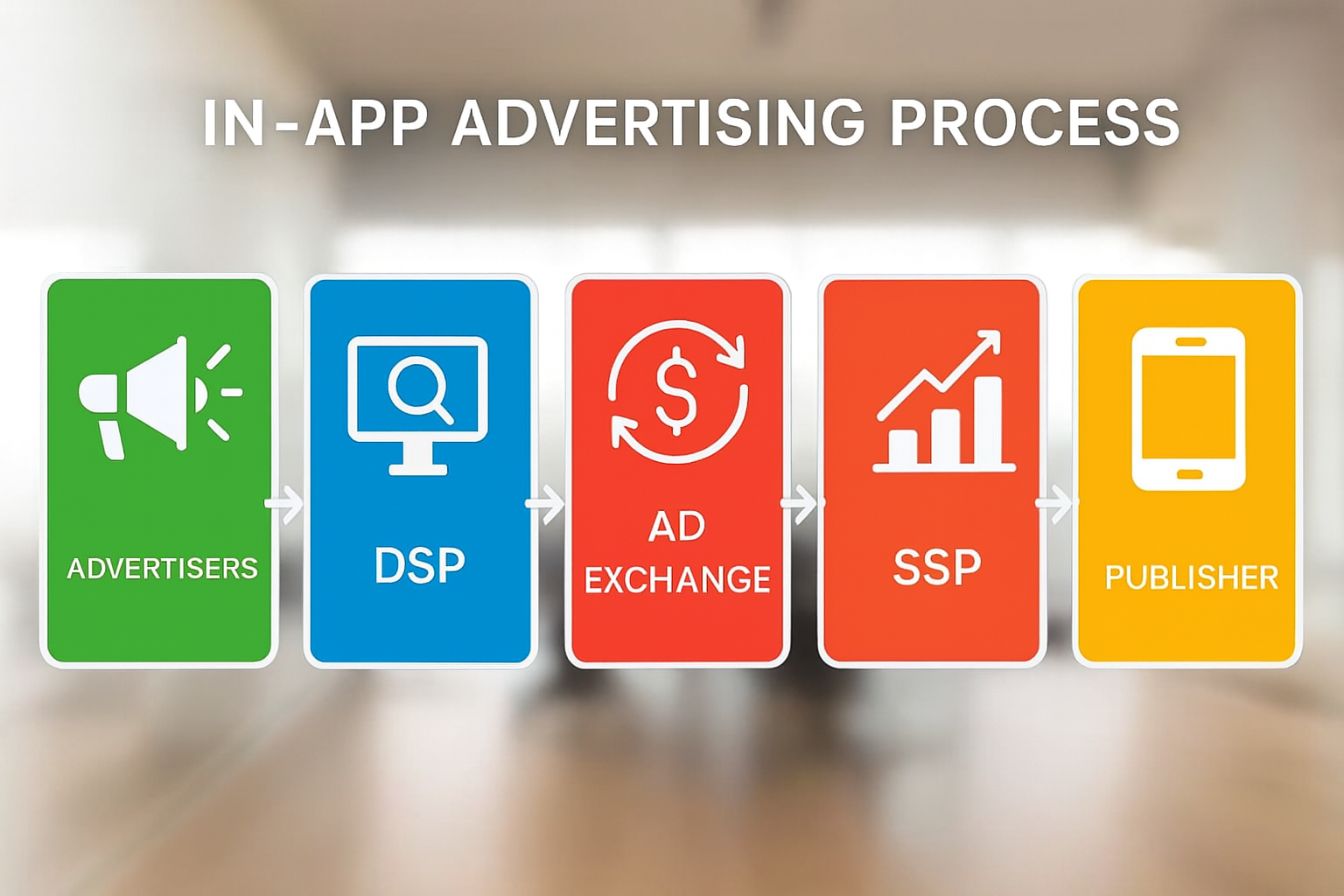
In-App Advertising in Action: The process explained
- Once an advertiser creates an ad campaign, the Demand-Side Platform uses data analytics and algorithms to target the desired audience, selecting the most efficient and relevant app to reach valuable users.
- The app owners’ goal is to maximize revenue from selling ad space. Since publishers are typically paid per ad impression or user interaction with the ad, it is in their interest to work with high-paying advertisers and display effective and engaging ads that generate strong performance.
- Advertisers work with ad networks and DSPs to launch and manage in-app advertising campaigns, purchasing digital space through ad exchanges to reach their target audience.
- The winning ad is displayed to users in real-time and their actions are tracked and reported back to advertisers. Based on this collected data, advertisers will be able to measure their performance and optimize the marketing campaigns.
There’s a wide range of In-App Advertising types, the diversification and the choice of which one to apply depends specifically on the app’s characteristics and benefits that each type of IAA provides.
Banner Ads
Rectangular visual ads placed on the top or bottom of a screen, often static or animated, to attract attention and drive traffic to the advertiser’s app. This type of ads are probably the most used and familiar to app users and moreover they are not very intrusive for them.
Benefits:
- Available on all types of screen
- Fast and easy to implement
- Supports High-volume execution
- Very cheap and efficient advertising format
Video Ads
A very popular choice amongst mobile marketers and the key to every mobile game’s success. This type of In-App Advertising is composed of short and highly engaging videos (ranging from 15 to 60 seconds) before, during or after other content.
A subset of this category is rewarded video ads: a format where users choose to watch a video or to engage with an interactive ad in exchange for in-app benefits (virtual currency, content/ level unlock).
Benefits
- Value exchange creation
- High engagement and revenue
- Excellent format to transmit core app characteristic
Interstitial Ads
Full screen ads that cover the app’s content, typically shown between different screens or transitions ( example moving between levels in a gaming app) not to irritate users instead of engaging them. Displayed both by animated and interactive rich media content the users have two options- to click it or to close it .
Benefits
- Large display space
- Higher level of consumer attraction
- High impression and high conversions number
Native Ads
Native Ads is a type of non-intrusive format that, matching app’s style, fits perfectly its design. More and more used by marketers, they appear naturally inside the display offering a less intrusive and more engaging user experience while still highlighting the new app or marketing campaign to promote.
Benefits
- Visibility advantages publisher related
- User experience improving
- Perceived as more trustworthy
Rich Media Ads
This category of IAA format comprehends all ads types that go beyond static images or simple banners as they are composed of interactive and dynamic promotions. The main goal using rich media Ads is to increase interaction rates providing the potential user an anticipated immersive experience.
Playable Ads: They consist of letting users interact with a mini-game or demo before downloading an app or taking action.
Offerwall ads: A specific type of format identifiable under rich media ads that consist of a screen listing multiple offers, most of the time rewarding benefits that users gain after completing a precise action.
In this paragraph we‘ll explore the tools to optimize In app advertising potential in the most efficient way.
Focus on Targeted Content
Tailoring advertisements to individual preferences enhances relevance and interaction. Segmenting your audience allows you to deliver content that appeals to diverse user segments, ultimately improving the effectiveness of your campaigns and boosting return on investment.
Utilize Engaging Video Ads
Video ads are particularly effective in mobile environments. Rewarded video formats, where users receive in-app benefits for watching, lead to increased completion rates and promote voluntary engagement, making them a powerful tool for app monetization.
Continuously Optimize Through Testing
Continuous experimentation is essential to identify which ad types and creatives yield the best results. A/B testing different placements, messaging, and pricing models helps refine campaigns and optimize future strategies.
Maintain a Seamless User Experience
Maintaining a positive user experience must remain a central focus. Advertisements should enhance the app using engaging visuals and relevant messaging that aligns with user intent. Poorly timed or intrusive ads can negatively affect perception and retention.
Ensure Ads Are Visible
Ensuring your ads are actually seen is fundamental to campaign effectiveness . Ads should meet industry viewability criteria, ensuring that a significant portion of the ad is under the sight of users for a sufficient duration to create impact.
Moderate Ad Frequency
Even the most effective advertising can have negative effects if overused. Presenting too many ads or irrelevant content could annoy users. Segmenting audiences carefully and pacing and controlling the frequency of ads delivery helps maintain engagement and prevents user churn.
Comply with Data Privacy Regulation
With increasing regulatory requirements, it is essential to manage user information responsibly. Complying with privacy laws while maintaining precise targeting ensures campaigns are both lawful and reliable, supporting sustainable revenue generation.
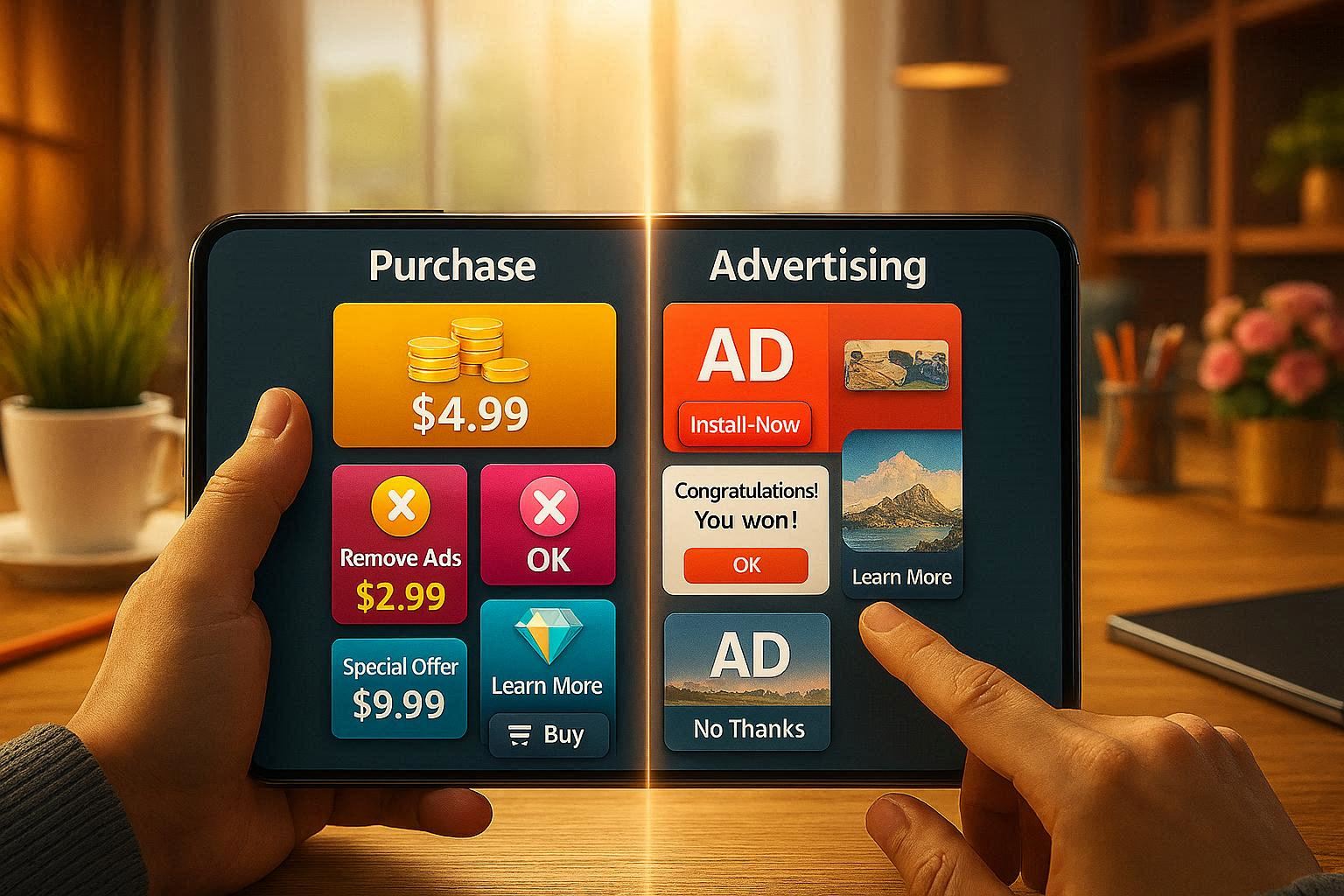
As most of the time those two specific monetization strategies are nominated together, let’s now have a look at the core differences between In App Purchases and In App Advertising summarizing their pros and cons into a concise and effective paragraph to explain how to optimize their concrete application.
- revenue potential: from the profit side In App Purchase is absolutely the winner as thanks to this revenue channel the advertisers are able to collect earnings directly from in app users. As, for this reason, IAP has the potential to generate more revenues, it is extremely important that consumers are able to see the real value offered by the company through the promoted content, with the aim to finalise the effective purchasement.
- user experience: The choice of monetization strategy has a significant impact on revenue generation. One of the key factors to consider to maximize profit related to them is surely how the two monetization methods interact with the users: IAA if not implemented correctly, can disrupt user experience, causing a strong disengagement. IAPs, on the other hand, can enhance and improve the experience of consumers providing them additional features or virtual goods to increase their interest and their retention.
- user acquisition: In App Advertisement enables an app to increase its user database but it can also increase the interaction of an already acquired audience. This surely leads to increased users which translates into higher retention rate and revenue. IAP is more focused instead on the increase of already acquired users.
- app type: The effectiveness of monetization strategies largely depends on the type of application. Advertising-based monetization (IAA) is generally more suitable for high-traffic apps with frequent user interactions. IAA are in fact very suitable for content-driven platforms, for example social, streaming, educational platforms, and hyper-casual mobile games: basically every type of app in which revenue is generated through impressions and clicks. In contrast, in-app purchases are often more effective in apps that offer added value through premium features, virtual goods, or enhanced functionality, such as games (action/ RPG/ Strategy/ simulation games), productivity tools, or subscription-based services.
Conclusion: Key Takeaways To Remember
This success of in-app advertising (IAA) relies on understanding its mobile ecosystem and how each player—from advertisers and DSPs to publishers, SSPs, ad networks, and measurement partners—contributes to campaign success.
IAA highlights the importance of balancing monetization with user experience, ensuring ads are visible but not intrusive, and maintaining compliance with privacy regulations to achieve sustainable revenue.
Ultimately, by comparing IAA and IAP, we’ve clarified when each strategy works best: IAA excels in high-traffic, interaction-heavy apps, driving user acquisition and engagement, while IAP generates direct revenue by delivering tangible value to users.