The global mobile gaming market has become one of the most competitive sectors of the app economy: with millions of games competing for attention in app stores and advertising networks, acquiring users is now more than just launching a campaign that brings in installs. In today’s market, success means acquiring the right kind of users at the lowest possible cost while maintaining profitability over the long term. That is why Cost per Install (CPI) is considered one of the crucial metrics in mobile game advertising, since it determines how efficiently marketing budgets are transformed into active players.
However, modern user acquisition does not involve simply obtaining the lowest CPIs anymore: as competition intensified and advertising platforms became more sophisticated, marketers have started to focus on the interaction between user acquisition, retention rates, lifetime value and return on ad spend. An ad campaign resulting in a smaller number of high-quality users might be more lucrative than one generating thousands of cheap installs. It is therefore essential for mobile game developers to understand how CPI works, what influences it and how it fits into user acquisition strategy, and explaining it is the aim of this article.
- What is CPI in mobile game advertising?
- How mobile game advertising works
- What factors influence mobile game CPI
- Why CPI has become a critical metric for mobile game growth
- How ad formats influence CPI and campaign performance
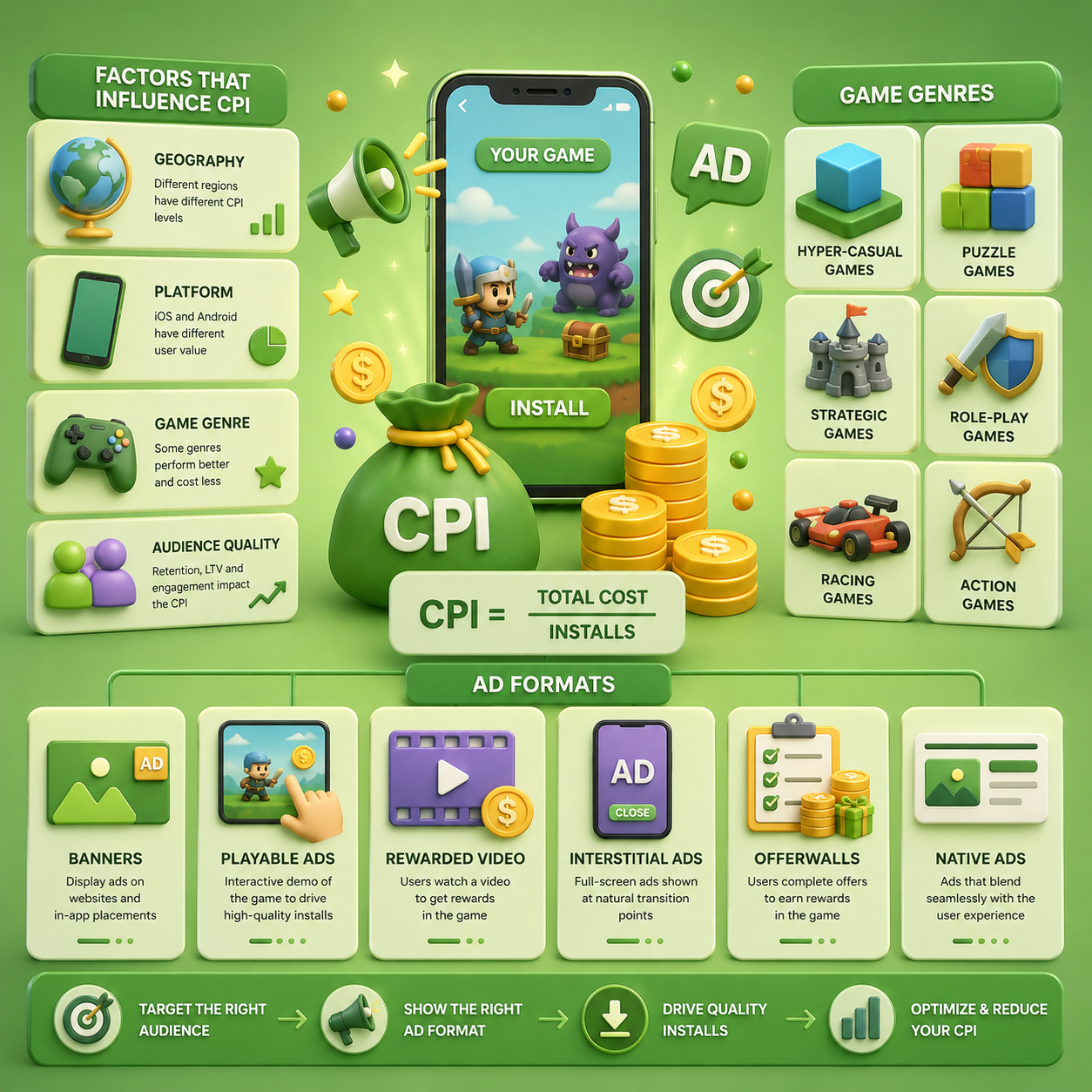
Cost per Install, abbreviated as CPI, is the pricing model most commonly associated with mobile app and mobile games user acquisition. With this model, advertisers pay only when a user installs and launches their game after interacting with an advertisement. This differs from CPM and CPC pricing models, in which the advertiser gets charged per impression or click, and ensures that marketing spend is tied to a measurable acquisition event. The formula used to calculate CPI is:
Cost Per Install = Total Advertising Spend ÷ Number of Installs Generated
The popularity of the CPI model depends on its ability to reduce risk for advertisers: rather than paying for clicks and traffic which may not necessarily generate conversions, developers only pay when users actually download their game.
In addition, the growth of programmatic advertising has reinforced the importance of CPI: today most mobile game advertising is conducted through automated ecosystems where competition for impressions takes place in real-time bidding auctions. Within milliseconds, an advertising algorithm processes thousands of variables, including user demographics, device information and behavioral patterns, to determine which advertisement is appropriate for a specific user.
As a result, CPI has become a far more complex metric than merely indicating the cost of acquisition, reflecting also market competition, audience quality and advertising efficiency.
In order to understand why CPI varies so significantly between campaigns, it’s important to understand how the mobile advertising ecosystem operates. The mobile games advertising industry essentially connects four primarily participants: game studios, advertising platforms, publishers and players.
Developers design advertising campaigns based on budgeting, target audiences and creative assets, and distribute them through ad networks and demand-side platforms (DSPs), which purchase ad inventory from publishers across thousands of mobile apps.
When a player comes across an advertisement, the platform decides whether that user is likely to install and engage with the game and, if the prediction is favourable, the advertiser may win the auction and display the ad on the user’s screen. If the user effectively installs and uses the app, the install is attributed through a Mobile Measurement Partner (MMP), which enables the advertisers to measure the campaign performance.
Since most campaigns operate within a competitive auction environment, acquisition costs depend on the number of advertisers targeting the same audience: when several game studios compete for the same high-value users, CPI naturally increases. This explains why acquisition costs vary from one campaign to another, especially in similar genres or geographic markets.
There is no universal CPI benchmark for mobile games because acquisition costs are influenced by many factors:
- Geographic targeting: the country being targeted is one of the principal factors that affects acquisition costs. Markets such as the United States, Canada, Germany and Australia are considered Tier-1 markets, due to their high purchasing power and monetization potential. Users in these countries are more likely to generate revenue through in-app purchases and advertisements, so competition among these markets is significantly high, as well as CPI rates. On the other hand, nations like Latin American countries, Southeast Asia and parts of Eastern Europe offer lower acquisition costs, but lower CPIs do not guarantee higher profits. While advertisers may acquire installs more cheaply, users spending behavior and advertising revenue can also be lower;
- Platform: operating system selection also plays a major role in determining CPI. iOs users have always demonstrated a stronger purchasing behavior than Android users, therefore CPI tends to be higher in Apple’s ecosystem than in Android’s. Based on benchmarks, gaming advertisers experience CPI ranges between $2 and $5 for iOS, and $1.50 and $4 for Android, depending on geography, audience segmentation and competition.
- Game genre: different genres attract different user bases, monetize in different ways and generate different levels of revenue, consequently acquisition costs vary depending on these factors. Hyper-casual games represent the lowest end of the CPI curve: they are designed around simplicity, short sessions and broad appeal, allowing developers to acquire large numbers of users quickly. Most hyper-casual games don’t rely on in-app purchases but on advertising, so their focus is on acquiring an impressive amount of users at a relatively low cost instead of few but high-value users. As a result, their CPI rates can fall below one dollar. The situation is different for strategy, simulation and role-playing games, which require greater commitment and engagement. Users of these categories tend to generate higher revenue through in-app purchases and, because of this, developers are willing to pay more in order to reach the target audience of the game. Competition increases bidding pressure, resulting in higher CPI rates that can exceed five dollars in Tier-1 markets. Puzzle, casual and mid-core games lie somewhere in between these two extremes, since their monetization strategies combine advertising revenue with in-app purchases, balancing between acquisition volume and user quality.
Over the years, CPI has evolved from a simple acquisition metric into one of the most important indicators of mobile game marketing performance. In the past, mobile game developers focused primarily on install volume, measuring growth through the number of downloads with little attention to post-install behavior. Today, rising advertising costs and stricter privacy regulations have shifted the focus toward acquisition efficiency and profitability. However, the importance of CPI is not determined by its value alone, but by how it relates to metrics such as ROAS, retention rates, LTV and Average Revenue per User (ARPU).
One of the most common misconceptions in mobile game marketing is assuming that the lowest CPI is indicative of the best performing campaign. While reducing CPI is important, focusing solely on that can lead advertisers toward low-quality traffic, which fails to generate meaningful business outcomes. A campaign with a low CPI might appear effective, but if its users uninstall the game after their first session, the overall campaign will be considered less successful than one with a much higher CPI, but which attracts users who engage, remain active even for months and make regular purchases.
Because of this, the most effective CPI is not necessarily the lowest one, but the one that allows advertisers to achieve their target ROAS. It is crucial to evaluate the user acquisition process in terms of the income earned by the users that were acquired, so a high CPI may be acceptable if it attracts users with stronger retention, engagement, and monetization potential. Since acquisition costs are influenced by factors such as geography, platform, game genre and ad format, CPI benchmarks should always be interpreted within the context of a campaign’s goals and expected player lifetime value.
Not all advertising formats generate the same type of user behavior: some prioritize reach and cost-effective acquisition, while others aim at engaging audiences likely to retain and monetize. This explains why ad format selection can influence both CPI and campaign profitability.
- Rewarded video ads are one of the most successful types of ads in mobile games, because they align the goal of the advertiser with that of the consumer. Users voluntarily watch a video advertisement in exchange for an in-game reward, creating a positive experience that encourages engagement. Since users decide to interact with the ads willingly, completion rates tend to be high, as well as post-install user behavior and monetization performance;
- Playable ads have emerged as one of the most effective means of acquisition in mobile games, since users, instead of just watching a video, engage with a miniature version of the game before deciding whether or not to install it. This approach provides an important advantage, since it allows the user to experience gameplay mechanics before installing. Consequently, installations obtained via playable ads can prove to be more qualified because the users know exactly what to expect from the game. This type of ad also helped improve retention, because of its ability to minimize expectations versus reality discrepancies;
- Interstitial ads cover the entire screen at strategic moments during the game, including when levels are completed or when switching between menus, creating strong visibility to drive substantial install volume. Nevertheless, the improper use of such ads can have a negative impact on user experience, in fact advertisers typically use these ads during natural pauses instead of interrupting gameplay;
- Banner ads have been among the most popular forms of mobile advertising from the very beginning and are still commonly used, especially for hyper-casual games. Their main benefit lies in their low cost and wide audience reach. Despite being less engaging than other formats, banners still have the potential to play an important role in the user acquisition process;
- Offerwalls and native ads both represent additional opportunities for advertisers looking for highly engaged users. In offerwalls, users are required to perform certain tasks in order to receive rewards, while native ads integrate naturally with the surrounding interface. Both generate highly motivated traffic and can complement acquisition strategies focused on maximizing player quality rather than increasing install volume.
Conclusion
CPI remains one of the fundamental KPIs in mobile game advertising because it provides a direct measure of user acquisition efficiency. However, as competition increases, CPI should be viewed as only a piece of a broader growth strategy. There are a variety of factors that can influence user acquisition costs, such as geography, operating system, game genre, competition and advertising formats, and being aware of these variables allows developers to interpret CPI benchmarks accurately and make smart budget allocations.
Most impostantly, advertisers need to avoid focusing solely on optimizing for the lowest possible CPI, since user acquisition campaigns aim at maximizing profitability instead of minimizing acquisition costs, balancing acquisition efficiency with retention, engagement, lifetime value and return on ad spend. In today’s mobile gaming landscape, the goal is not simply to acquire more installs, but to acquire the right users, who remain engaged, generate revenue and contribute to sustainable long-term growth.